






Back pain in everyday life – when is a back belt enough and when should you consult a doctor?


Back pain can occur to anyone - after overexertion, improper movement, prolonged sitting or injury. In such cases, the question often arises as to how to relieve discomfort and continue daily activities without harming the health of the back.
A back brace can be a practical solution for mild to moderate pain, helping to relieve pressure on the lower back and provide additional stability. However, it is important to understand when you can use a brace on your own and when you should discuss its use with your doctor. In this article, we explain when a back brace can help and when you should consult a specialist.
When a back belt can help before consulting a doctor or in cases of minor injuries
A lumbar support may be a good solution if the pain is mild to moderate and there are no dangerous symptoms. It can help relieve the lumbar region, stabilize the back, and reduce discomfort while waiting for a doctor's consultation. In such cases, the support can usually be used independently, observing a reasonable wearing time and monitoring how you feel. A lumbar support helps reduce the load, improve posture, and allow the back to "calm down." However, if you had planned to deal with your back pain "at home" and do not feel any improvement, a doctor's consultation is recommended. A consultation with a family doctor will also be useful, as he will be able to assess the situation professionally and provide recommendations for further action.
Typical symptoms in cases where an orthosis can help relieve discomfort and pain:
- dull, pulling pain in the lower back
- have acute or chronic low back pain without additional neurological symptoms
- stiffness after sleep or prolonged sitting, or a feeling of tiredness in the back at the end of the day
- discomfort, but without sharp, shooting pain
- pain caused by overload or microtrauma (improper movement, heavy lifting)
- need additional support during daily activities – at work, at home, while moving around
- have muscle weakness or a feeling of instability in the lumbar region
- The pain is recurring but has been manageable so far. For example, you have had similar complaints in the past and your doctor has recommended using a back brace to reduce discomfort, stabilize your back, and allow you to continue your daily activities.
Cases in which the use of a back brace is usually recommended by a doctor
There are situations when a lumbar orthosis is part of a treatment or rehabilitation plan, and its use is recommended to be coordinated with a doctor or physiotherapist. In these cases, the orthosis serves not only for comfort, but also to stabilize the spine and promote recovery, reducing the load.
Typical symptoms in these cases:
- regular or constant lower back pain
- worsening pain during movement
- stiffness that doesn't go away with rest
- back “fatigue” even after light exertion
- pre-determined diagnosis
A back brace/back belt is usually recommended by a doctor if:
- diagnosed degenerative processes in the spine
- has a herniated disc but no acute neurological disorders
- spondyloarthrosis or spondylolysis has been detected
- rehabilitation is taking place before or after surgery
- requires longer spinal stabilization in a controlled manner
In such cases, a back brace helps reduce pain, limit excessive movement, and protect the spine, but it is used for a certain period of time and in combination with exercises or other therapy.
When should you definitely see a doctor?
A back brace is not a substitute for a medical diagnosis. Even if you have had similar complaints in the past and a back brace has helped in the past, it is always advisable to consult a doctor, as back health is very important. A minor problem that goes undiagnosed for a long time can become a serious health problem over months or years.
You should definitely consult a doctor if:
- the pain does not go away or gets worse within 7–10 days
- pain radiates to the leg, tingling or numbness appears
- there is loss of strength in the legs
- urinary or bowel control problems occur
- pain occurred after a fall or serious injury
- have a fever or unexplained weight loss along with back pain
RAL experts recommend the following back belts
The choice of back belt depends on the nature of the pain, the intensity of the load and daily activities. To ensure adequate support for the lumbar region and at the same time maintain comfort, RAL specialists have compiled a list of back belts that are most often recommended for daily use, during the rehabilitation period or after increased physical exertion.
We remind you that it is recommended to consult a doctor about choosing a back belt.
Back belt – DonJoy Lombostrap
DonJoy Lombostrap is a high-quality back belt that is suitable for situations where the lumbar region needs additional support, but comfort is also important.
This back belt is suitable for mild, chronic or acute lower back pain, as well as after minor injuries or overload, when the back needs stability, but not complete restriction of movement.
Thanks to the elastic, breathable fabric, the belt is comfortable to wear all day long – it allows the skin to breathe and reduces discomfort even during active everyday life. The 4 elastic back straps and 2 flexible abdominal straps built into the design provide balanced support for the lumbar area, helping to reduce the load on the spine and improve posture control. The tension straps are particularly practical, allowing you to individually adjust the compression level depending on your well-being and activity. In turn, the finger loops make it easy to put on and take off the belt, even if your back is sensitive or painful.
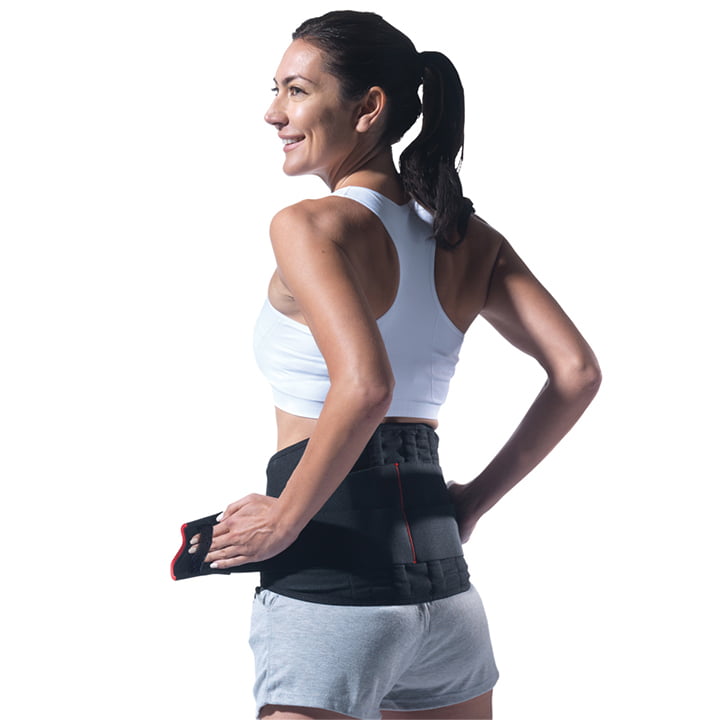
DonJoy Lombostrap is a combined model suitable for both women and men, and is available in two height options - 21 cm and 26 cm, as well as 3 sizes - S, M and L. The size is determined by the pelvic circumference (1 cm below the navel), ensuring a precise and comfortable fit to the body.
Learn more about the DonJoy Lombostrap back belt .
The main advantages of the DonJoy Lombostrap back belt/corset:
- Breathable and comfortable materials – suitable for long-term everyday wear
- Adjustable, balanced support – stabilizes the lumbar region while maintaining freedom of movement
- Suitable for both men and women
- Excellent quality-price ratio – available locally!
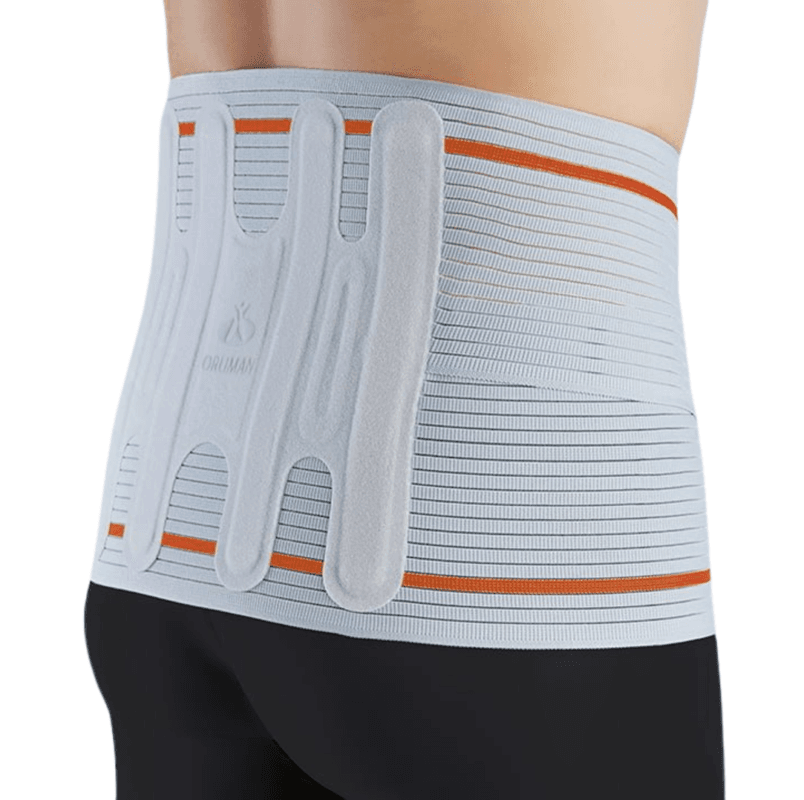
Back belt - Evotec, Semi-rigid Lumbar Back Support
It is ergonomically designed and provides stability , support and comfort to the lumbar region during daily activities, during rehabilitation or after minor strains and injuries. It is designed for people who need an additional feeling of support and controlled compression in the lumbar region, while not losing relative freedom of movement and comfort.
The semi-rigid design combines the comfort of a flexible material with firmer lower back support. This belt provides better lumbar support than flexible belts, but is less restrictive than a fully rigid orthosis.
The orthosis is made of a dense, elastic material that provides approximately 50% more compression than conventional materials, thus increasing support for the lumbar area. The “Meshlai” - mesh-like construction uses a seamless sewing technique to reduce friction and ensure comfortable wear throughout the day. To ensure a precise and comfortable fit to the body, this back belt is available in 7 different sizes. It is suitable for both women and men.
Instructions and areas of use
This back belt is recommended for use in various situations where back stabilization, compression, or assistance in improving muscle activity is needed:
- Lumbago (low back pain)
- Degenerative processes (e.g., aging changes in the spine)
- Muscle weakness or atony in the lumbar region
- Disc herniation (without acute neurological symptoms)
- Spondyloarthrosis (wear and tear of joints)
- Spondylolysis
- Rehabilitation before or after operations on the lumbar spine or related structures.
Learn more about the back belt (Semi Rigid Lumbar Back Support) – M1/M10 .
The orthosis is suitable for use both in daily activities and during minor physical tasks when additional support for the lumbar spine is needed, while maintaining ergonomic movement functionality. This orthosis can also be used in the postoperative period.
Also take a look at other back belts offered by RAL.
Frequently asked questions
01. Can I sleep with a back belt on?
Usually not. The back belt is intended for daytime activities. Sleeping with it on is only permissible if recommended by a doctor (for example, after surgery or in case of acute pain).
02. If I use a back belt, when should I feel improvements?
A lighter feeling of support and greater safety of movement already in the first days, pain relief within 3–7 days. If there is no improvement within 7–10 days, you should consult a doctor or physiotherapist.
03. What activities can be done with a back belt?
A back belt or back brace is designed to support and facilitate movement, not restrict it , so you can do the following with it:
- Walking
- daily household chores
- Work involving standing or sitting – prolonged sitting at a desk or prolonged standing at the workplace
- light physical work
- rehabilitation exercises, if recommended
Not recommended:
- intense sports without specialist advice
- lifting heavy weights without proper technique
04. How long should I wear the back belt?
A back brace should not be worn continuously all day long, as prolonged use can weaken the muscles. If the pain and/or discomfort does not subside, you should definitely consult a doctor. A back brace can also be worn prophylactically – daily during exertion.
- For acute pain: 1–2 weeks, mainly during active movements, as recommended by a doctor. For acute pain, we always recommend professional consultation.
- For chronic pain: as needed, combined with exercise.
- After surgery: only as directed by a doctor or physiotherapist.

































 Free shipping on orders over €100
 Pay in installments or use leasing - for orders over €75. Learn more ›