Free shipping on orders over €100
 Pay in installments or use leasing - for orders over €75. Learn more ›





From the first insulin pumps to smart diabetes care: MiniMed innovations


For diabetics, technological advances mean much more than just smaller devices or faster processors. They can mean fewer injections, better understanding of glucose levels, more freedom in daily life, a better quality of life, and less need to constantly make decisions related to diabetes management.
The advancements in insulin delivery and glucose monitoring technology over the past 30 to 40 years have been impressive. Devices that once took up an entire desk or had to be carried around like a backpack have evolved into compact insulin pumps, wearable continuous glucose monitoring sensors, or CGMs, and automated insulin delivery systems that can adjust therapy based on glucose data.
MiniMed has been part of this evolution since the early stages of modern insulin pump technology. The company's history, which later continued as Medtronic , shows how long-term research and development can gradually transform an ambitious medical idea into practical, safe and patient-friendly solutions.

From injections to continuous insulin delivery
Many years ago, insulin control and administration for diabetic patients relied on repeated manual injections. The ambitious idea of continuous insulin delivery promised significant changes and improvements in the quality of life of patients.
The challenge: glucose measurement and insulin administration as a single process
Some of the first attempts were very different from the pumps patients know today. 20. In the 1960s, experimental systems were large and mechanically complex. One of the early closed-loop concepts monitored glucose levels through an intravenous line and used separate pumps for insulin and glucagon. Although this technology was not suitable for everyday use, it demonstrated an important principle: glucose measurement and insulin delivery could work together. This was a major step in the development of subsequent technologies that we take for granted today.
Challenge: Mobility
In the 1970s, developers began to reduce the size of insulin delivery devices. Dean Kamen's AutoSyringe, developed in 1976, was a major step towards a portable infusion system. The development of precision motors later allowed for the control of very small movements and thus the delivery of the required amount of insulin to the patient with greater precision.
MiniMed, founded by Alfred Mann in 1983, evolved during this period of rapid experimentation. The company’s early commercial pumps helped move from repeated injections to programmable, continuous insulin delivery. This shift wasn’t just a matter of convenience. It also posed a whole new engineering challenge: a device that continuously delivered a potent drug had to be reliable and precisely controllable.

Initially, this solution raised concerns among both users and doctors about accidental over-injection of insulin due to technical failure. Therefore, the development of insulin pumps required extensive testing studies, very strict safety controls and the accumulation of experience. Over time, the technology became more reliable, safer and more accurate.
A radically different approach: an implantable insulin pump
MiniMed's work was not limited to external pumps. In the late 1970s, Alfred Mann assembled a team of engineers to explore an even more ambitious idea: an insulin pump that could be implanted in the human body. The project was carried out in collaboration with NASA and the Johns Hopkins University Applied Physics Laboratory. The result was the Programmable Implantable Medication Delivery System, or PIMS, which was designed to deliver insulin into the intraperitoneal cavity rather than subcutaneous tissue.
This difference was important because this route of administration can better mimic certain aspects of the body's natural insulin action. The technology progressed from an idea to clinical trials. The first such pump was implanted at Johns Hopkins Hospital (USA) in 1986, and further clinical trials continued in the following years.

One patient who later became closely involved with the technology was Greg Peterson. He received his first implantable pump in January 1992 as part of a clinical trial. According to Peterson, the early studies focused on safety and system effectiveness. In addition to effectiveness and quality of life improvements, early implantable pump patients, doctors, and scientists faced challenges related to batteries, catheters, communication components, insulin stability, and maintenance. Patients and engineers were effectively pioneers, learning together how to use and improve the new technology.
Some patients became very loyal to the system. Peterson used implantable pumps for about 30 years. When support in the United States became limited, he flew dozens of times from California to France to get the necessary maintenance for his device.
These individual patient experiences should not be taken as clinical evidence that automatically applies to all patients. However, they do illustrate another important point: diabetes technology is not only about the technical aspects, but also about how the patient feels and how comfortable the system is to use on a daily basis.
Watch the video where you can see and learn more about the technologies described above and their development.
Glucose monitoring is a game changer
While insulin delivery technology was evolving, another major change in glucose measurement was occurring at the same time. The early home glucose meters that became available in the 1970s. Back then, they were large devices. Measuring glucose required significantly more time and effort than today, and each measurement only showed a single point in time. This was a major limitation. For example, a glucose reading of 120 mg/dL did not, by itself, tell us whether glucose levels were rising, falling, or remaining stable. Continuous glucose monitoring changed that.
MiniMed introduced one of the early CGM solutions in 1999. Compared to today’s discrete sensors, it was a bulky, body-worn sensor that was connected to a relatively large device that the user had to carry with them. Later generations introduced wireless data transmission, and the devices gradually became smaller and more convenient. Despite its initial limitations, CGM fundamentally changed diabetes management.
Instead of individual measurements, patients and doctors could begin to see glucose trends that occurred after meals, during exercise, and at night. This continuous stream of data paved the way for an even more important step: connecting the glucose sensor to an insulin pump.
From glucose monitoring to automatic response
2001. In 2011, Medtronic acquired MiniMed, integrating the company's insulin pump and CGM technologies into its broader medical device portfolio. In the years that followed, the two technologies were increasingly combined. 2025. In 2011, Medtronic used the pump hardware as a CGM receiver. A year later, MiniMed allowed CGM data to be displayed directly on the insulin pump and alerted the user when glucose levels were too high or too low. At this stage, the patient still had to interpret the information and make their own decisions about what to do.
The next step, therefore, wasn't just a better sensor or a better pump. It was the introduction of automation.
Algorithm-driven safety feature
2013. In 2011, the Medtronic 530G introduced an algorithm-driven safety feature that could suspend insulin delivery in response to low glucose levels under certain conditions. This was a major turning point: the pump no longer simply followed preset commands from the user. Glucose data could automatically influence insulin delivery. From there, automated insulin delivery continued to evolve to today’s hybrid closed-loop systems.
Such systems regularly analyze CGM readings and adjust background insulin delivery to help keep glucose levels within a specific target range. The patient still participates in some treatment decisions, particularly regarding meals, hence the term “hybrid closed loop.”
As a result, several technological elements developed over decades are combined into one system: accurate glucose sensors, reliable insulin pumps, wireless communication, and increasingly complex control algorithms.
Competence that develops over decades
The history of MiniMed's development helps us understand what competence really means in the field of medical technology. Expertise doesn't come from one successful product. It comes from years of solving complex problems.
- How to accurately inject a very small amount of insulin?
- How to ensure pump reliability during long-term, continuous use?
- How to continuously monitor glucose levels without making the patient's daily life even more complicated?
- What should the system do if glucose levels start to drop?
- How can the sensor, insulin pump, and software work safely as a single system?
- And increasingly importantly, how can technology take over a greater part of diabetes management without becoming a new source of burden for the patient?
MiniMed and Medtronic have been working on various versions of these questions since the 1980s and 1990s. That history includes successful commercial products, experimental systems that were never widely implemented, discontinued technologies, and ideas that are being re-examined today as engineering capabilities have expanded.
The implantable insulin pump is a particularly good example. Although development of the previous generation of the system was discontinued, the idea itself has not disappeared. 2026. In a 2018 Diabetech interview, Peterson said that Medtronic/MiniMed is developing a new implantable system called Phoenix, and that the devices have already been implanted in patients in France and the Netherlands in early studies.
In the same interview, it was noted that the development strategy is to focus on insulin delivery first and potentially integrate automated insulin delivery later. This reflects a broader principle of medical innovation: sometimes a good idea comes before all the necessary technology is ready.
Better batteries, electronics, sensors, algorithms, materials and communication solutions can turn yesterday's complex idea into tomorrow's real solution.
The patient remains at the center of innovation
The evolution of diabetes technology from large experimental pumps to today's connected systems is easy to describe as an engineering story. But it's really a story about reducing the daily burden of diabetes.
- A smaller sensor is important because a person can wear it 24/7.
- A more reliable pump is important because insulin delivery must work whether the patient is working, exercising, or sleeping.
- Accurate alerts are important because they can help you avoid dangerous low or high blood glucose levels.
- Automation is important because every decision a system can safely make for a patient potentially means one less diabetes decision a person has to make for themselves.
- And comfort is important, because even a technically excellent device is less valuable if the patient finds it too cumbersome for prolonged use.
That’s why MiniMed’s history is especially relevant in the context of today’s diabetes sensors and insulin delivery systems. The company has operated through multiple stages of technological development, from early pumps and experimental implantable solutions to CGM integration and algorithm-guided insulin delivery. Each of these stages has created knowledge that helps shape the next generation of technologies.
The MiniMed 780G is one of the most advanced automated insulin delivery systems available commercially, combining continuous glucose monitoring with an adaptive algorithm that automatically adjusts insulin delivery and regularly performs automatic insulin correction doses. More information about the MiniMed 780G .
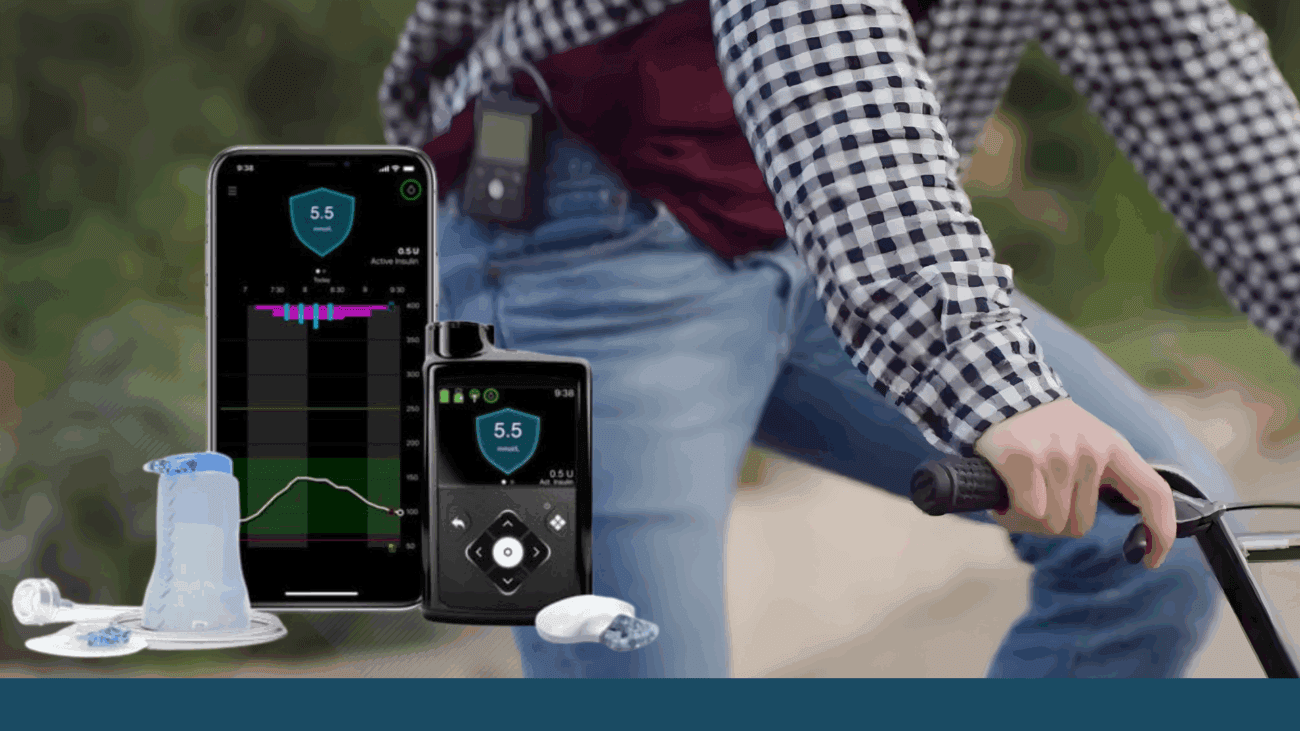
The next stage: increasingly autonomous diabetes management
Diabetes technologies have moved from periodic glucose measurement to continuous monitoring, from manual insulin administration to automated and continuous input, and from simple data display to systems that can automatically respond to this data.
Future systems aim to require less patient intervention while helping to keep glucose levels within a safer and narrower target range. Whether progress is made through ever more advanced wearable systems, new implantable technologies, or a combination of both, continuous glucose monitoring will remain essential.
This development is particularly significant for sensor manufacturers and suppliers. The glucose sensor is no longer just a measuring device. In an automated insulin delivery system, it becomes part of a continuous decision-making cycle.
The sensor's accuracy, reliability, wearing comfort, and ability to communicate securely with other devices directly impact the overall capabilities of a diabetes management system.
More than four decades of MiniMed research and development demonstrate why progress in this industry requires not only innovation, but also patience. Technologies must be tested, improved, and sometimes completely redesigned. Safety and performance must evolve alongside comfort and ease of use.
MiniMed offers the best technological solutions for diabetes patients that are safe, proven and reliable. However, they do not consider these solutions to be the absolute achievement and the best possible solution. Research continues, technologies are developed so that the next generation of products will be even more convenient to use, smaller and more effective.